The first time to really understand the workflows behind your own processes. Have you ever wondered what the limitations of process mining are? Have you ever questioned the level of detail that Process Mining (PM) analyses represent? Well say, questions I have never thought about before – why should I? After we developed the first data-driven approach to find automation potential based on data using techniques from process mining and mathematical optimization, we learned it the hard way. Despite the possibility of objectively narrowing down potential and making comparisons, the question remains: How do I automate this? What happens within the individual process activity that I consider to have potential? A question that perfectly highlights the limitations of process mining techniques for finding and preparing automation projects.
Task Mining as a solution
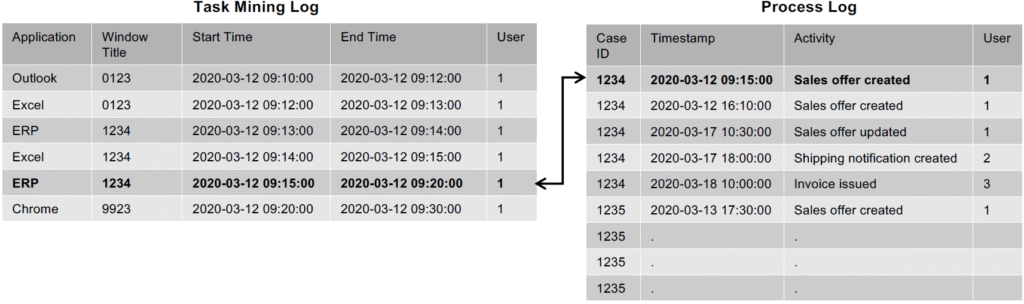
The answer to this question can be found in the research field of Task Mining. By recording user activity data, it is possible to understand how certain tasks are performed. In other words, it offers the possibility to understand what happens during a process activity on the workstation of a respective user. This is, which programs are used, how are actions taken within the screens, where do clicks or keystrokes occur. The question is always to what extent the activity that happens there often happens in a similar way in further cases. And now imagine if you know this across multiple users. Isn’t that powerful? So, I get the opportunity to determine whether certain tasks reveal patterns to highly standardized activity sequences that I’m able to automate.
In our article Process Selection for RPA Projects – A Holistic Approach, we demonstrate how this new capability removes the limitations of information from pure Process Mining. By combining the two data sets, in-depth analyses can be performed. So, as mapped, it can be understood how work is actually done in each stage of the process. In some use cases, the level of detail from a pure ERP data log is sufficient in terms of process mining. For the search for automation potential and its technical implementation, however, Task Mining can become a real game changer. This creates the possibility to really understand how tasks are performed to automate repetitive and low-cognitive tasks with this knowledge. Due to the high shortage of skilled workers and the enormous task load on the company’s own staff, this is a first opportunity to reallocate the company’s resources in a meaningful way. So the next time you want to do an automation project or have one planned, come see us. It is the #stage of analysis that is critical for the overall success. Avoid unforeseen shortcomings in later phases through a data-based analysis of your automation potential!
Task mining does not deliver the same level of benefit everywhere. The technology is particularly effective where digital knowledge work, manual activities, multiple systems and a high degree of variability come together. This article provides a practical overview of typical use cases, roles and business areas in which task mining – especially with Paxray –
Task mining has established itself as an important technology for analysing and optimising digital business processes. But not all task mining is the same. Similar functional descriptions can conceal fundamentally different technological and methodological approaches. This article shows how Paxray differs from other task mining providers – not only in terms of data protection, but
Task mining solutions are not a classic software rollout, but rather a structured improvement project. A clear process is crucial to achieving transparency, acceptance and reliable results. This article explains step by step how a typical task mining project with Paxray works – from defining objectives to data protection and data collection to analysis, measures




 Learn more