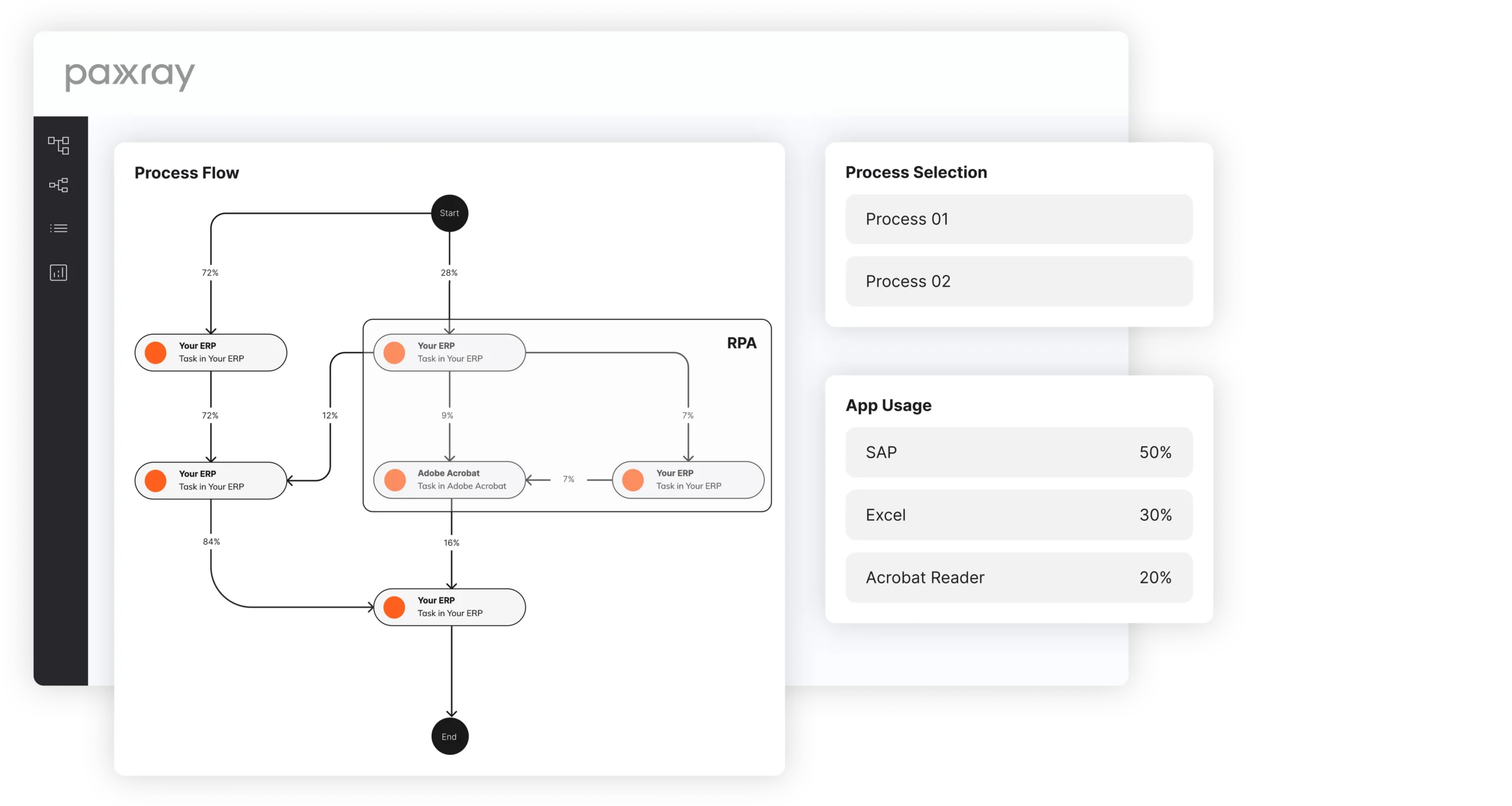
Paxray x-rays your digital processes across tools, teams, and systems through task mining. Identify inefficiencies and automate what matters most — in days, not months.
Paxray showed us where and how optimizations in our teams are worthwhile, helping us align our implementation priorities. We were already on a good path, but can now become up to 40% more efficient in high-potential areas
Michael Neumann
Managing Director, NETZSCH Business Services GmbH
Paxray shows how work really happens – providing the data foundation for optimization, automation, and AI.
We automatically capture real workflows across tools, teams, and departments – without disrupting daily operations. From Excel to browser apps to core systems – every step is captured seamlessly.
Identify where processes slow you down and where small changes have big effects and ROI. Set the right priorities, achieve efficiency gains, and make daily work smoother for everyone.
"Paxray showed us where our team was truly losing time. Take our invoicing process, for example: it used to take 12 minutes due to necessary adjustments during invoice creation — now it only takes 2. The clearly demonstrated potential convinced even our management to move forward with the implementation.”
Galina Makus
Team Lead Accounts Receivable,
Consilio GmbH
"We were impressed by how quickly Paxray was up and running across several hundred employees and multiple countries. It saved us countless interviews ahead of the S4 migration and finally gave us a cross-system view of how processes really work in practice.”
Steffen Liedmeyer
IT Team Lead Process Optimization,
apetito AG
"Paxray helped us identify process gaps and time wasters that we would have only discovered through significant manual effort. What impressed us most was how quickly trust was established, always with the goal of becoming more effective. Paxray’s sensitive approach and transparency from the very beginning made a big difference.”
Sascha Ebert
Head of Business Unit IT,
KOMSA AG
Free Whitepaper
Process Analysis 2.0
70%
of process optimization initiatives fail – and how to fix avoid this with task mining.
Paxray records real processes independent from API’s and integrations, fully anonymized.
Install & Capture
Paxray is installed as a lightweight client runs in the background. It records task-level workflow data — like clicks, opened tools, and switchovers between applications — fully anonymized and without capturing screens, keystrokes, or personal content. Employees can work as usual — Paxray observes processes, not people.
Map & Analyse Processes
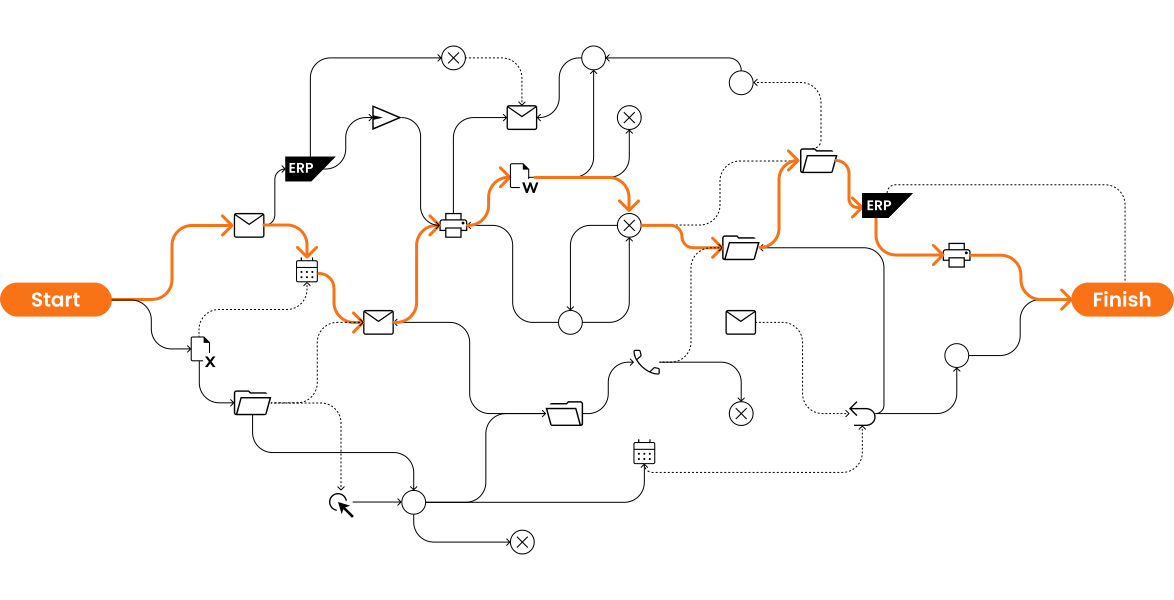
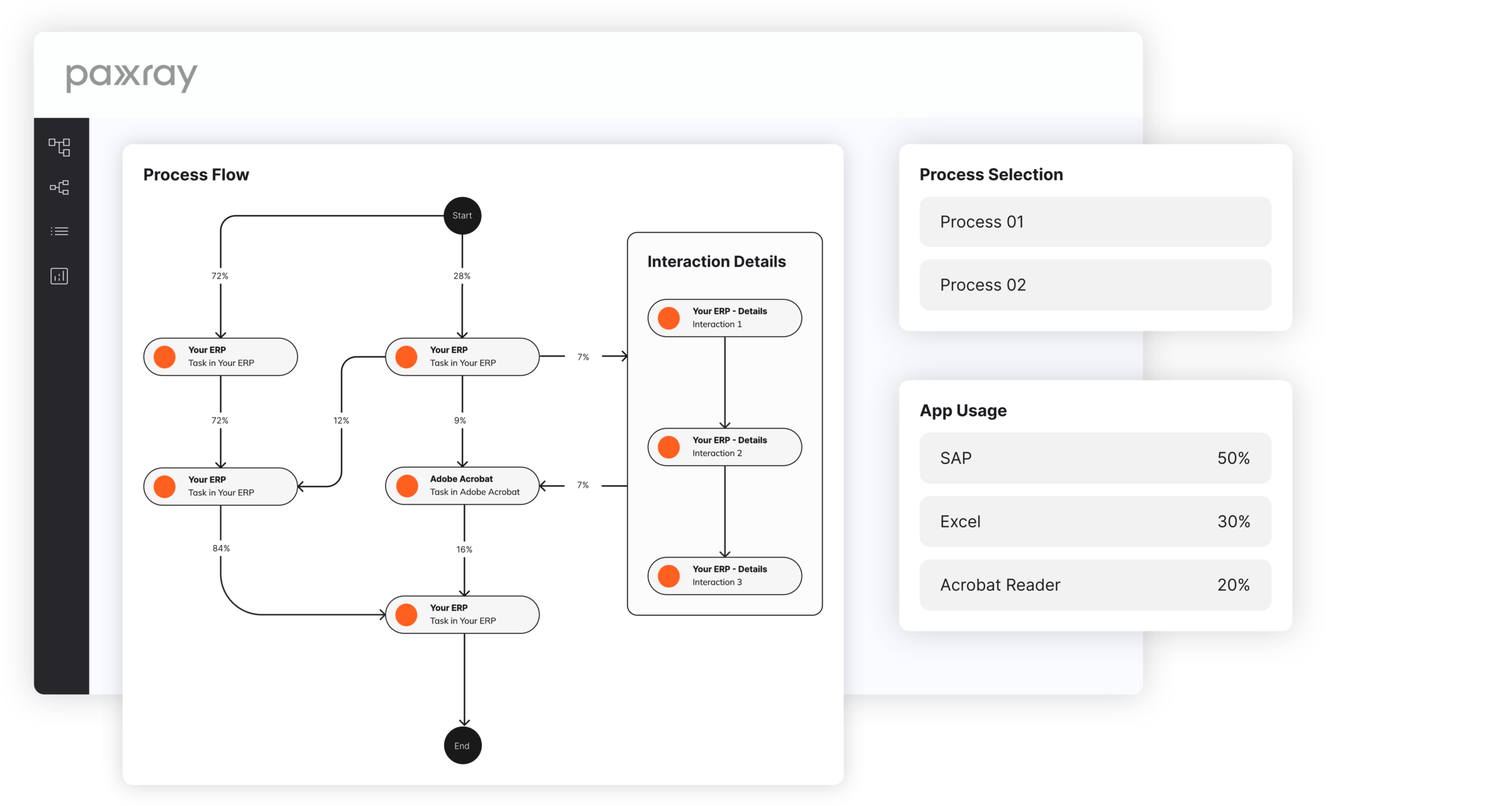
The collected data flows into the Paxray analytics engine. There, advanced algorithms and AI reconstruct actual end-to-end workflows by stitching together thousands of small actions into clear process paths.
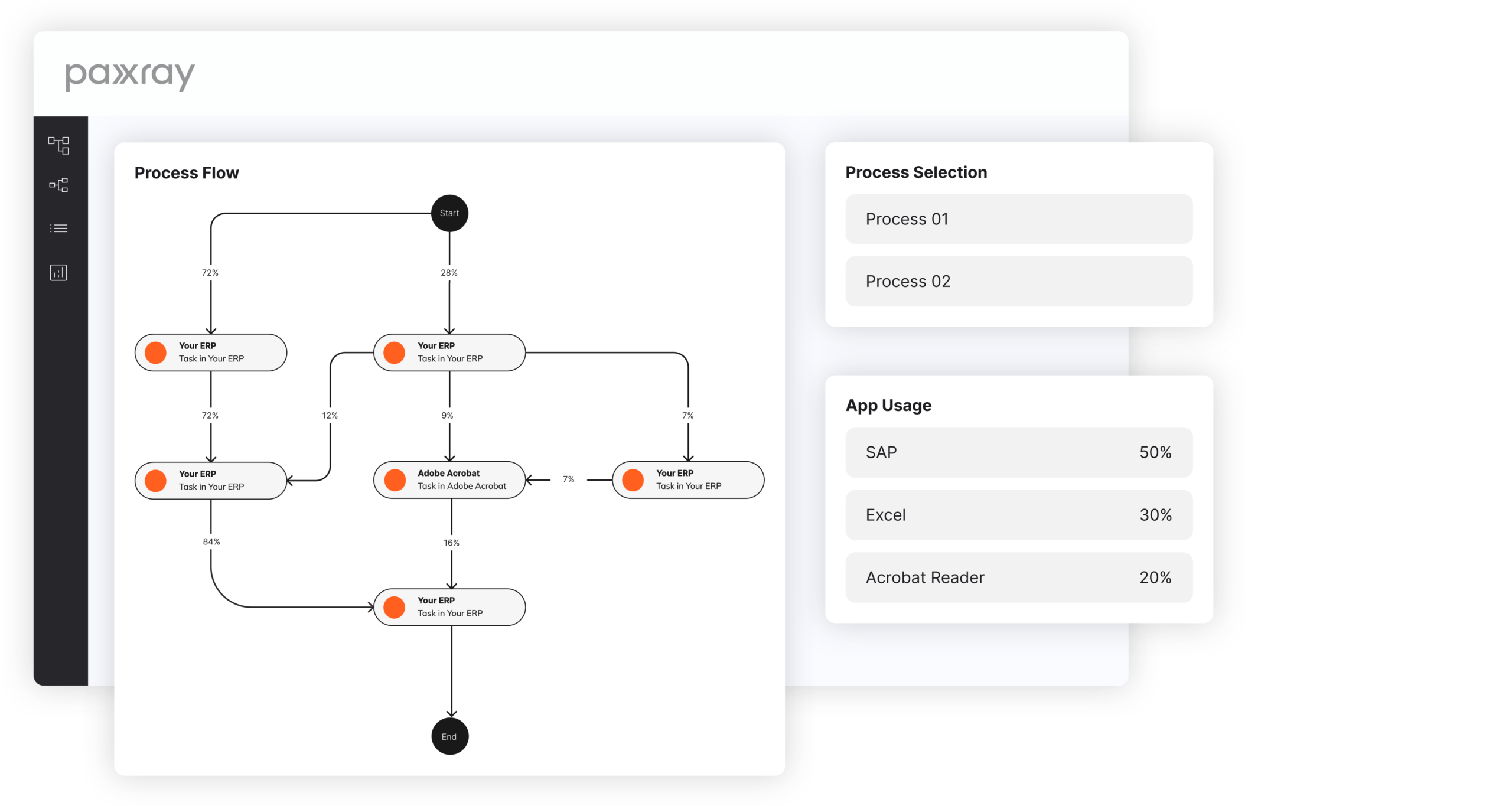
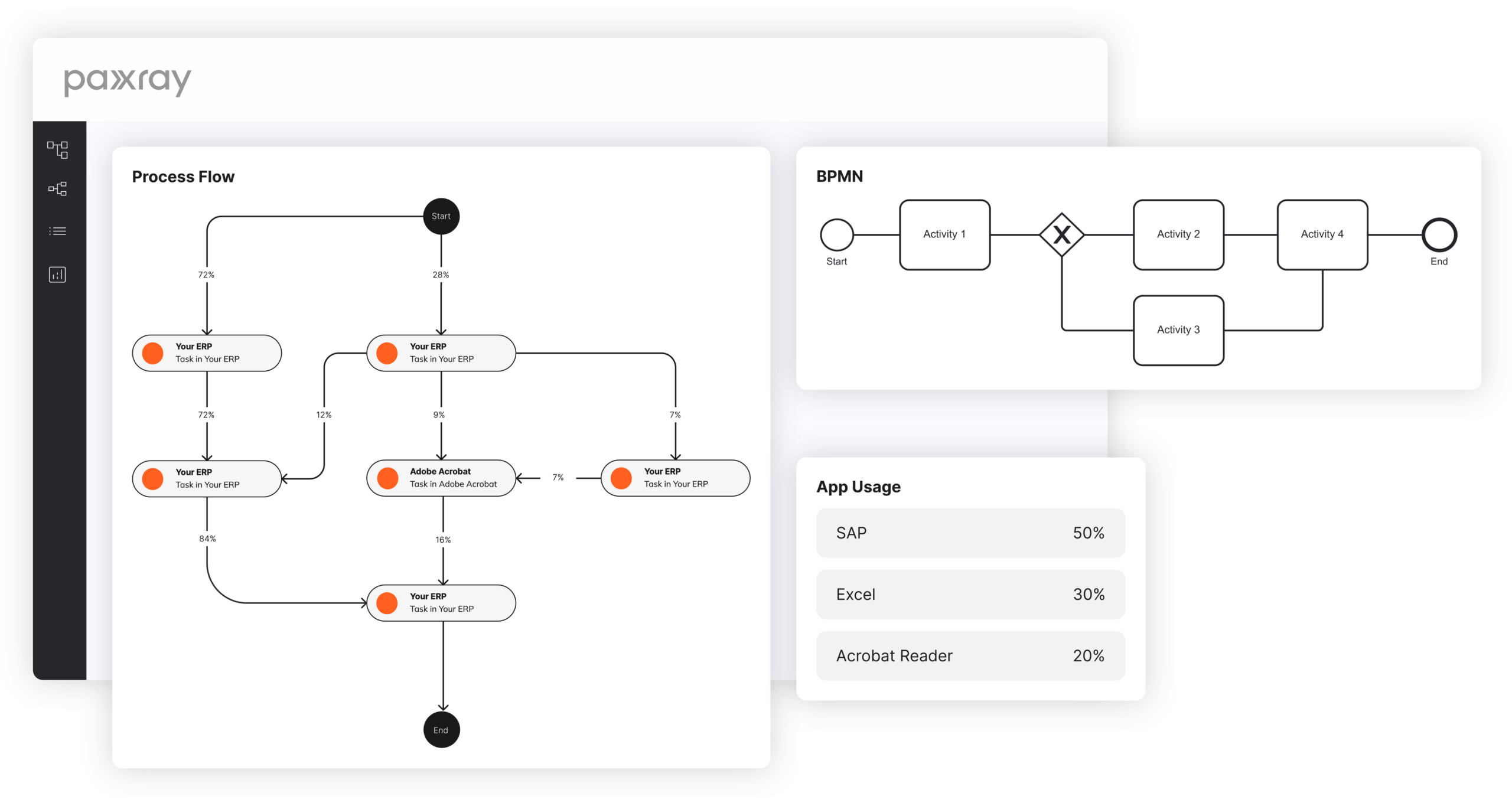
You receive visual process maps (exportable to BPMN 2.0), dashboards with performance metrics, and variant overviews — showing where processes branch, slow down, or deviate.
Optimize & Improve
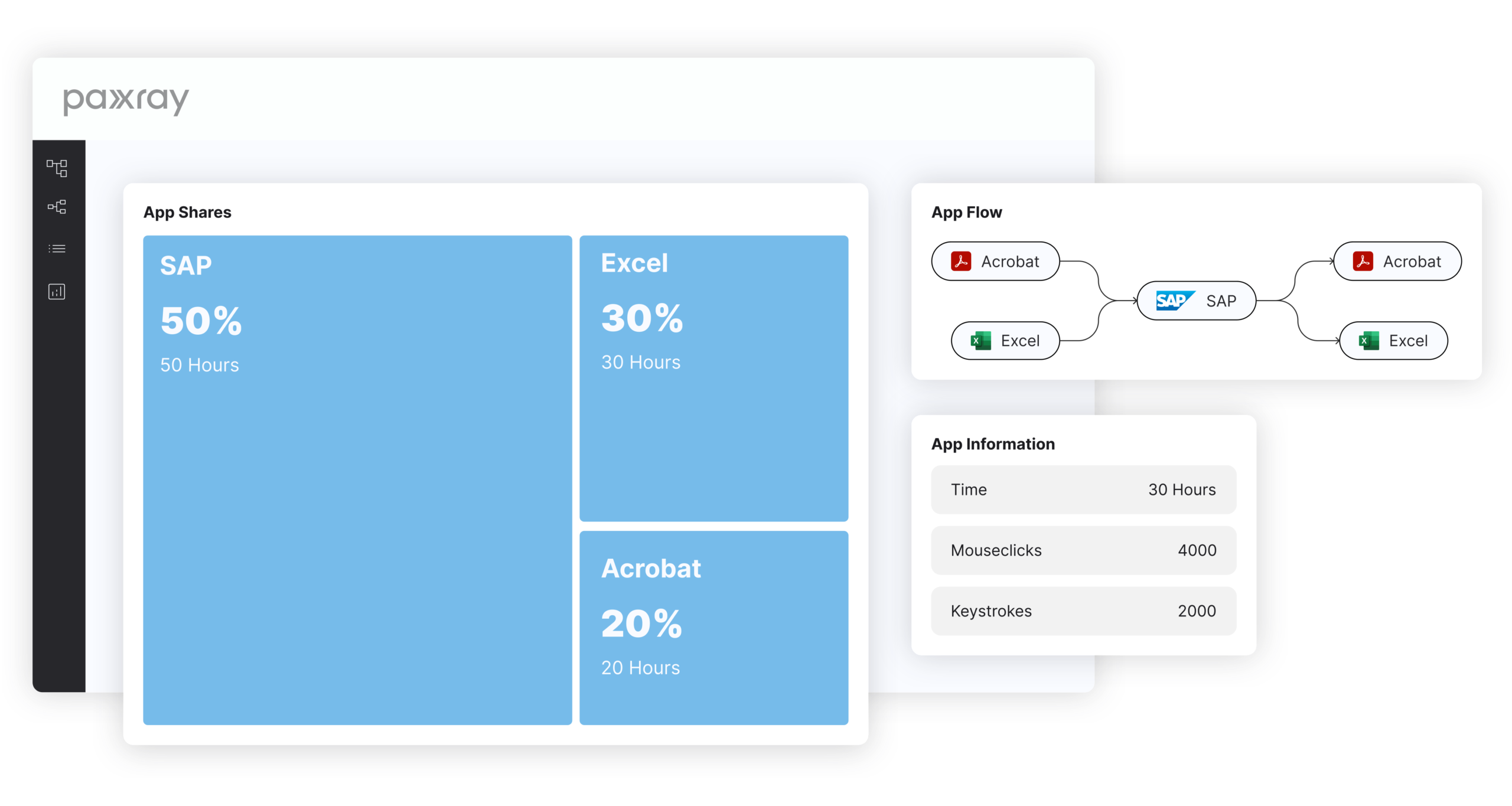
With full transparency, you can spot bottlenecks, inefficiencies, and automation potential — all backed by real data. Paxray helps you reduce manual work, deploy RPA bots, or redesign workflows by showing what to fix first and how to measure impact. You can also track specific objects — like order numbers or case IDs — across systems to see where they slow down or go wrong.
How Paxray is helping customers to become more efficient
Are your main systems used correctly? Or are employees still spending too much time in Excel? Find the processes where automation actually pays off.
Paxray highlights where repetitive manual steps occur — so you know exactly where RPA or AI can drive measurable impact. No guessing. No wasted budget.
Automatically capture real processes instead of relying on subjective opinions.
Get a comprehensive and fact-based view of how work is done — while saving employees valuable time during surveys and interviews.
Know what to migrate — and what to leave behind. Paxray uncovers how your processes really run today — including workarounds in Excel or email — so you don’t rebuild outdated workflows in your new ERP system.
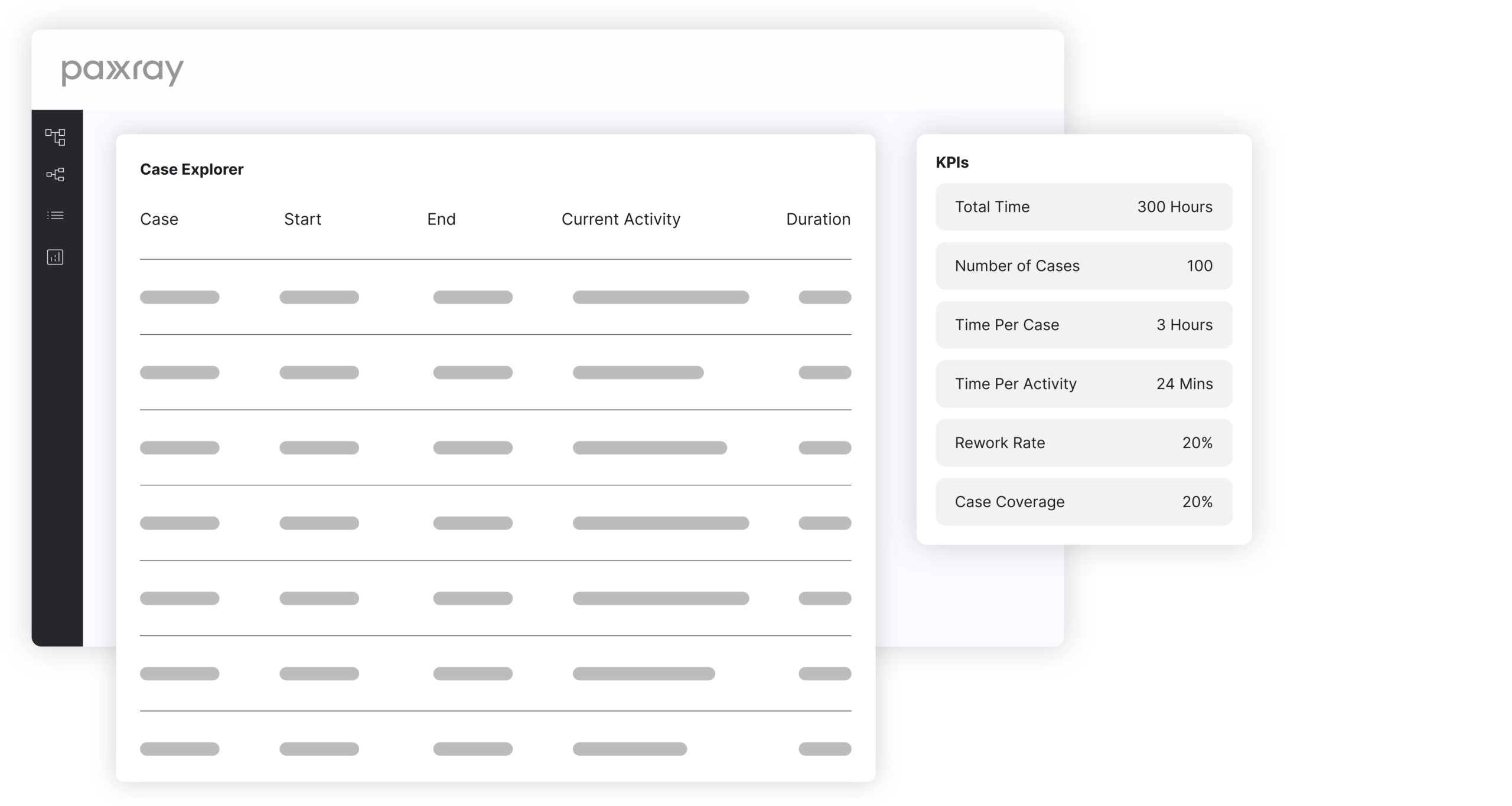
Track specific cases (e.g. orders, IDs) across tools and teams to understand delays, handovers and exceptions. Perfect to measure process KPI such as Number of operations, deviations and variants, throughput times, erros andcompare actuals vs target.
No. Paxray was deliberately designed so that the evaluation or monitoring of individual people is technically impossible. The solution focuses exclusively on workflows and process patterns – never on individual performance.
Why individual people are not visible:
• All data is anonymised directly on the local device.
• Each recording requires the involvement of at least three employees; all interactions are then consolidated into a single, aggregated dataset.
• No content is captured: no texts, no screenshots, no fields, no passwords, no keystrokes.
• Any conclusions about individual people or behaviours are systemically impossible.
This results in a tool that makes processes objectively visible without exposing employees.
Paxray creates transparency around problems in the process – not around people. Teams finally gain access to data that makes their day-to-day challenges visible and supports them, rather than controlling them. In many cases, Paxray even has a relieving effect, because long-known bottlenecks and unnecessary manual steps can finally be substantiated with evidence.
Paxray does not capture any sensitive or content-related data and is fully GDPR-compliant.
The software does not read texts, document contents, emails, passwords or keystrokes. No screenshots or videos are created.
Paxray operates using a purely interaction-based task mining technology. Only technical interactions such as clicks, window switches, navigation steps and events are captured. Content itself is never processed or stored.
The only technical exception is the detection of keyboard shortcuts such as Ctrl+C to determine that a copy action has taken place – not what was copied.
All personal references are anonymised or pseudonymised directly on the local device. In addition, whitelisting and blacklisting ensure that only the minimum necessary amount of data is collected. The data is encrypted and can be processed either in a German cloud or fully on-premise.
In short: Paxray analyses processes – not content – and meets the highest standards of data protection and security in the EU.
We do not deliver off-the-shelf solutions. Instead, we support you from the pilot project through to continuous optimisation. Our experience shows that task mining projects achieve the highest ROI when clear objectives and hypotheses are defined upfront and validated using data.
Typically, you receive a comprehensive analysis of your real-world workflows – combining a solid current-state analysis with clearly quantified improvement potentials and concrete, actionable recommendations.
Typical outcomes include:
• An executive summary with key insights and recommended actions
• A current-state analysis of systems and processes, including variants and time drains
• Target-state processes and prioritised measures, ranging from quick wins to automation
• KPIs, monitoring approaches and exportable BPMN models
Our ambition does not end with analysis. We move straight into execution and support implementation together with your team or our partners.
In short: Paxray delivers clear decisions, prioritised actions and measurable results.
The results are available to you in multiple formats – depending on how you would like to continue working:
• Directly within the Paxray software: interactive process views, variants, time analyses and system paths
• Analytical results report (PDF): management summary and detailed analysis
• BPMN export: process models for tools such as Camunda, Signavio, BIC or Visio
• Additional formats available on request: e.g. PowerPoint, CSV data or customised documentation
Paxray is ideal for digital, manual and cross-team processes that involve frequent system changes. It is particularly well suited to situations where employees themselves want to simplify workflows and existing documentation is incomplete or outdated.
Typical characteristics of suitable processes:
• a high number of transactions per day
• multiple roles or departments involved
• high manual effort (copy & paste, data entry, research, etc.)
• many tools in use
• a high degree of process variation
Suitable functional areas:
• Sales (quotations, orders, lead processing)
• Customer Service & Inside Sales
• Procurement & supplier management
• Finance & accounting
• HR / recruiting / onboarding
• Production planning & logistics
Relevant roles:
• Process Excellence
• Automation teams (RPA, AI agents)
• C-level & management
• Operational business teams
Migrations rarely fail because of technology — they fail because processes are incompletely documented or misunderstood. Paxray creates an objective data foundation that shows how workflows actually operate in reality.
Benefits of Paxray before and during migrations:
• True current-state processes: instead of interviews or outdated Visio diagrams
• Up-to-date process landscape: many migrations start with outdated or missing documentation. Task mining creates a current process map
• Reduction of legacy complexity: workshops, interviews and Visio diagrams provide subjective descriptions — but not real workflows. Paxray helps streamline processes before migration
• Clear prioritisation based on an objective view: prioritisation is often driven by gut feeling rather than relevance or effort. Paxray shows what should be migrated first
• Precise requirements: without real data, wish lists, unnecessary customisations and costly special solutions often emerge. Task mining shows what the new system truly needs to support
• Tool consolidation: many organisations lack transparency into which tools are actually used or where redundancies exist. Task mining supports clean-up and consolidation.
The result: migrations become faster, more cost-effective and lower-risk through task mining in the preparation phase.
Paxray documents processes automatically and objectively by capturing real workflows over several weeks and translating them into clearly structured process representations – without reading any content or personal data. Instead of theoretical models, this creates a real, up-to-date view of how work is actually carried out.
Below is a simple step-by-step overview of how Paxray supports organisations with process documentation:
1. Execute the target process once
An employee performs the target process once.
During this step, Paxray “learns” the basic structure purely through interactions such as clicks, window switches or application navigation.
2. Automatically capture real workflows
Over a defined period, Paxray records anonymised interactions in day-to-day work – across systems (ERP, CRM, email, browser, Office, etc.). This results in an objective and complete process landscape.
3. Make hidden operational details visible
Paxray reveals factors that are almost always missing from traditional documentation, such as time sinks in data entry.
The result: a realistic picture of lived processes – not theoretical target processes.
4. Prepare processes in a structured and easily shareable way
Based on the data, Paxray generates automatic process models that teams can immediately reuse, such as BPMN diagrams for tools like Signavio, Camunda or Visio.
5. Create a foundation for compliance, transformation and automation
The documented processes include all relevant variants, dependencies and complexities.
This enables many initiatives to be implemented significantly faster and more reliably, including:
• ISO certifications and audits
• Process and risk reviews
• RPA or AI automation projects
• Modernisation of IT systems
• ERP / CRM migrations
• Post-merger integration
• Identification of redundant software
Paxray makes process documentation objective, scalable and immediately usable for optimisation and transformation.

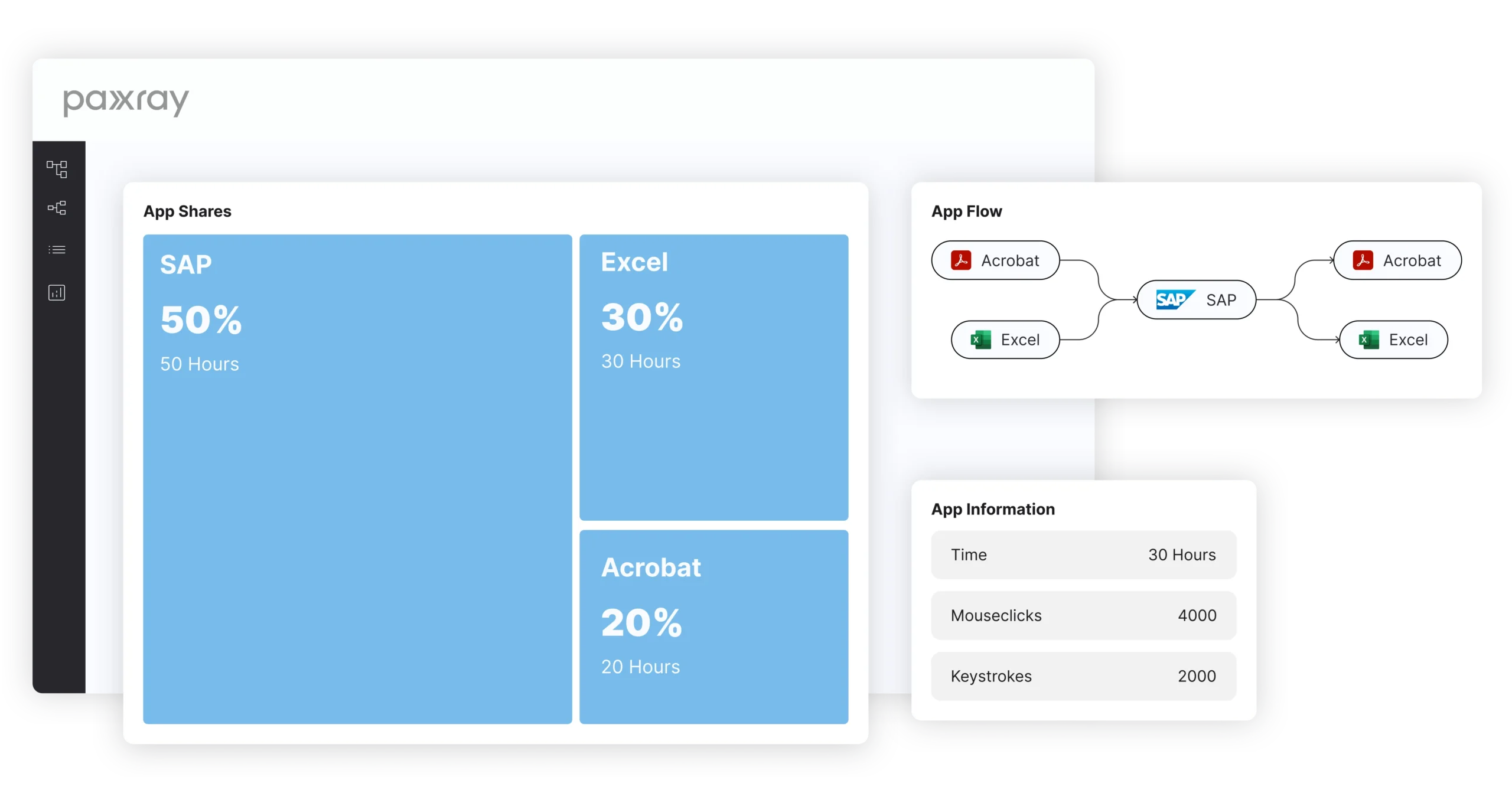
Paxray makes processes measurable by analysing processing times, frequencies, variants and effort per step. This allows teams to immediately see where time is lost, where ways of working differ, and which steps are unnecessarily complex.
Core capabilities:
• precise time measurement per activity
• variant comparison and identification of best practices
• cost calculation per process and per individual case
• ROI-based prioritisation for optimisation and automation
• continuous monitoring
This creates quantifiable improvement potential and clear priorities for process optimisation.
Paxray creates transparency around real workflows and makes efficiency potential measurable. Different roles across the organisation benefit from this:
• Business / Process Excellence gain an objective data foundation, identify bottlenecks and prioritise improvements based on facts rather than assumptions.
• AI and automation teams (RPA, AI agents) quickly identify processes with high ROI and use precise process models for implementation.
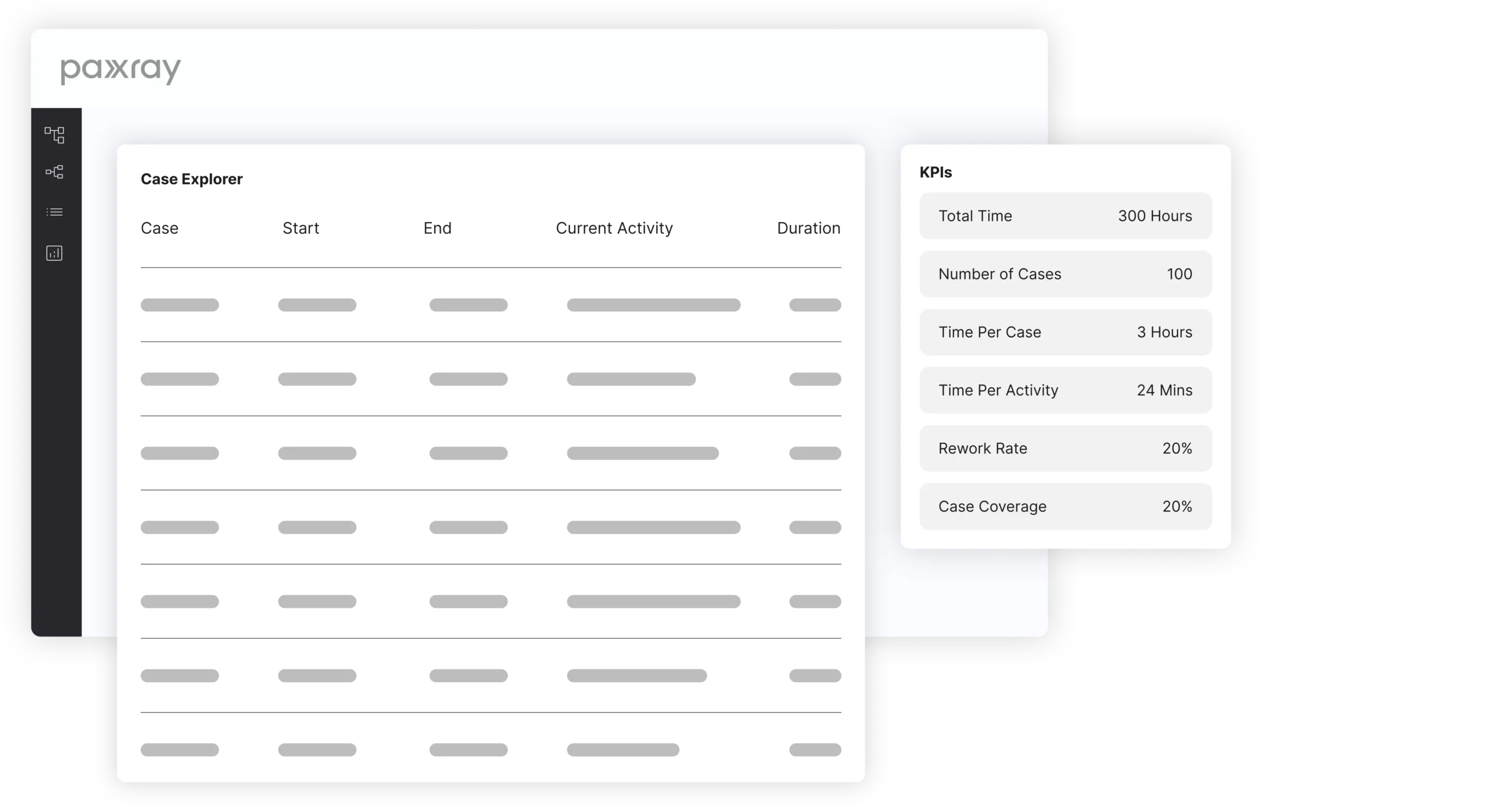
• C-level & management gain a clear overview of efficiency, costs and improvement potential, creating the foundation for continuous improvement.
• Operational teams gain a tool to drive improvements directly from day-to-day work and benefit from more stable, smoother processes.
Employees know their processes in detail and often have a clear sense of where things break down. Paxray connects this domain knowledge with objective data and, for the first time, makes problems transparent and measurable.
Instead of repeatedly pointing out inefficiencies, teams gain a robust instrument to substantiate inefficient steps, manual effort and time sinks with hard numbers. This enables improvements to be justified on solid grounds and investments to be secured where they truly pay off.
The result: less manual work, clearer processes and a tangible relief in day-to-day work. Employees actively shape their processes instead of merely being “affected” by them.
Process mining shows what happens in your core systems.
Paxray shows how work is actually carried out – across all tools, including Excel, email, browsers and manual activities.
This is where Paxray closes the gap that process mining cannot capture:
media breaks, manual steps, variants, copy & paste, waiting times and real-world workflows.
With no API integrations required, ready to start in less than one day, fully anonymised and ideally suited to making efficiency potential visible that remains hidden in event logs.
In short:
Process mining shows the system – Paxray shows reality.
Together, they provide a complete view of your processes.
Interviews and observations remain valuable, but they only provide subjective and point-in-time insights. Processes have become more complex, more variable and more digital — and many variants remain invisible in conversations. Paxray complements these methods with objective data from real day-to-day work.
Why interviews alone are not sufficient:
• subjective and dependent on memory
• time-consuming for teams
• variants, exceptions and workarounds remain hidden
• no reliable, quantifiable metrics
What Paxray adds:
• objective data collected over several weeks
• cross-system transparency (ERP, CRM, Office, browser, etc.)
• real workflows instead of theoretical descriptions
• clear prioritisation based on effort, frequency and ROI
Together, this creates a complete and reliable view of processes.
A value stream analysis is an excellent starting point. It creates structure, a shared understanding of processes and makes waste visible – especially at a conceptual level. Many of our customers have already completed this step successfully.
What is often missing afterwards is an objective view of day-to-day operations: How are processes actually lived and executed?
This is exactly where task mining complements value stream analysis. Paxray makes the lived reality visible across all tools in use and measures time spent and frequencies instead of relying on estimates. This makes differences between best practices and inefficient ways of working transparent.
Value stream analyses help to systematically develop hypotheses for process improvement.
Paxray provides the objective data foundation to validate these hypotheses in daily operations, prioritise them and assess them economically based on impact and ROI.
This ensures that processes are not only understood, but improved in a fact-based and sustainable way.
Many organisations are already automating today – often based on experience and gut feeling. What is frequently missing is a systematic and objective foundation for identifying the best automation opportunities.
Process documentation is often outdated or too high-level. Automation teams may know what they want to automate, but not in detail how processes actually run in day-to-day operations – including variants, workarounds and manual loops. At the same time, not every process step is suitable for AI or RPA. Many automations fail to deliver value because implementation effort and ongoing maintenance costs outweigh the benefits.
Based on real usage data, Paxray shows how processes are truly executed, where time is lost, which steps can be automated – and which cannot. Each step is quantified by frequency, effort and cost.
This makes it clear which initiative delivers which ROI – from quick wins to RPA or AI automations. Paxray helps teams prioritise automation in a targeted way and secure investments.
Paxray can typically be rolled out by IT within one day in an on-premise setup, or even within one hour in the cloud.
Unlike process mining, Paxray does not require any API connections to your core systems – the need for complex technical integration is completely eliminated.
The client runs minimally invasive and resource-efficient in the background, without disrupting day-to-day work.
Initial results and reliable process KPIs are usually available after just a few weeks.
No. Paxray has only a minimal impact on system performance and uses less than 1% CPU.
The client runs unobtrusively in the background, consuming fewer resources than a single browser tab.
Paxray can be operated fully on-premise via a virtual machine. Setup typically takes 1–2 days.
Alternatively, deployment via the Azure Cloud (Frankfurt region) is usually possible within one hour.
Stay Updated
Join our mailing list to receive the latest insights on process optimization, task mining trends, and automation best practices. No spam — just smart, actionable content from Paxray.