

Documenting processes with task mining: How companies can record their workflows realistically and automatically

Reliable process documentation is a key prerequisite for efficiency, compliance and successful transformations. In practice, however, it often fails due to manual, subjective and quickly outdated methods. This is where task mining comes in: it automatically and objectively captures real workflows based on actual user interactions. The following article explains why traditional process documentation has its limitations, how task mining overcomes these shortcomings, and what specific added value Paxray offers companies.
Why traditional process documentation has its limitations
Today’s companies face the challenge of documenting their processes in a transparent, efficient and comprehensible manner. Regulatory requirements, audits, automation initiatives and IT transformations are significantly increasing the need for robust process foundations. Nevertheless, much process documentation continues to be based on interviews, workshops or manually created flowcharts. However, these methods usually only provide snapshots and primarily reflect subjective perceptions.
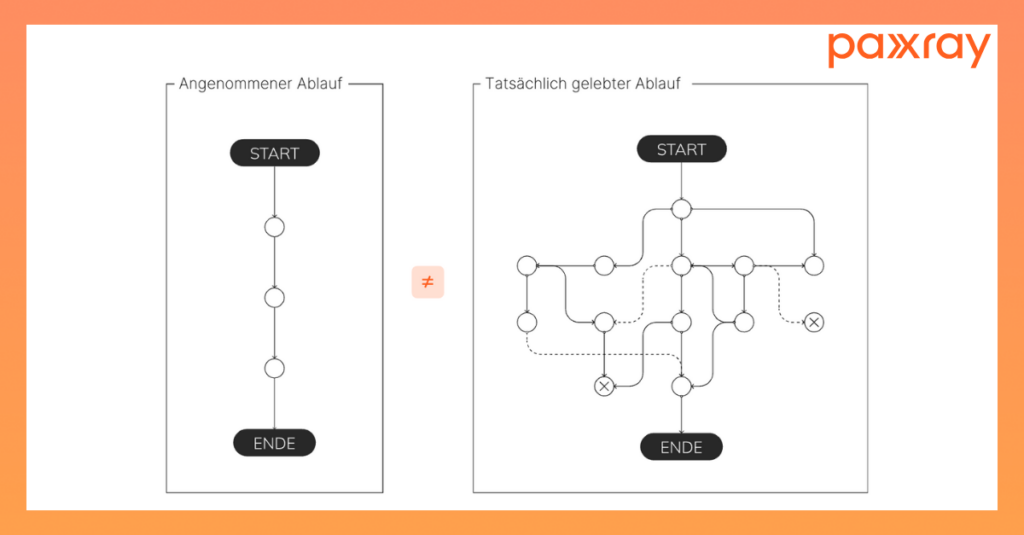
Employees often describe processes as they are intended or officially communicated – not necessarily as they are actually carried out in everyday life. Implicit knowledge, individual workarounds, media breaks between systems and additional manual steps are often not taken into account. The result is documentation that quickly becomes outdated and is only of limited use as a basis for operational improvements, audits or transformations. Industry studies show that insufficient understanding of processes is one of the main causes of failure in transformation and automation projects (Gartner, 2024; Deloitte, 2023).
What task mining does and why it fundamentally changes process documentation
Task mining takes a data-driven, bottom-up approach to process analysis. Instead of relying on assumptions or retrospective descriptions, task mining analyses real user interactions at the workplace level. It captures not only system events, but also manual activities, application changes and media breaks. This creates a realistic and complete picture of actual business processes.
Unlike traditional process mining, which is primarily based on event logs from source systems, task mining closes the gap between system processes and human work. This approach provides crucial additional insights, especially in knowledge-intensive, semi-automated processes. Scientific studies show that only the combination of system and task data enables a reliable view of processes (van der Aalst, 2022).
Automated and realistic process documentation with Paxray
Paxray uses a front-end-based task mining approach to document processes automatically and across systems. It captures real processes across ERP and CRM systems as well as activities in Office applications, browsers or specialised software. This allows step sequences, variants, frequencies, waiting times and technical dependencies to be precisely traced.
A key aspect of the task mining solution of Paxray is its data protection-compliant approach. The recording module is trained once using a defined ideal process. Paxray then automatically recognises the process and any deviations – without capturing content, screenshots or personal data. This mechanism makes implementation much easier and ensures acceptance by data protection officers, works councils and employees.
The result is up-to-date, fact-based process documentation that not only shows the nominal process, but also variants, operational peculiarities and actual effort.
From documentation to strategic management tool
The process documentation generated by task mining is much more than a static artefact. It forms a robust basis for numerous strategic initiatives. These include ISO certifications and internal audits as well as automation projects, IT modernisations, system migrations and post-merger integrations. Since processes are continuously recorded and updated, changes and optimisation potential can be tracked on an ongoing basis.
In addition, the transparent presentation of real processes enables fact-based discussion of processes across departmental boundaries. Processes can be visualised, analysed and used as BPMN models in training courses, workshops or onboarding programmes. Process documentation thus evolves from an administrative obligation to an active control tool for operational excellence and digital transformation.
Conclusion
Task mining makes process documentation objective, scalable and permanently up to date for the first time. Companies gain a realistic picture of how work is actually performed – not how it is theoretically planned. Paxray provides a solution that combines automated process documentation with data protection, high acceptance and strategic added value. This makes process documentation a reliable basis for informed decisions, sustainable efficiency gains and successful transformations.
References
Gartner (2024): Market Guide for Process and Task Mining Tools. Gartner Research. Available at: https://www.gartner.com/document/market-guide-process-task-mining (Accessed: 4 November 2025).
Deloitte (2023): The Rise of Task Mining: Bridging Human Activity and Automation Insights. Deloitte Insights. Available at: https://www.deloitte.com/insights/task-mining (Accessed: 4 November 2025).
van der Aalst, W.M.P. (2022): Process Mining and Beyond: Exploring Task-Level Behaviour. Information Systems, 108. Available at: https://www.sciencedirect.com/science/article/pii/S030643792200030X (Accessed: 4 November 2025).
Start your data-driven optimization today.
No integrations. No development. Live in 1 day.
