Why interviews and observations are no longer sufficient for modern process optimisation
Julia
Interviews and observations have been established methods of process analysis for decades. They provide valuable insights into context, expertise and ideas for improvement within organisations. At the same time, they are reaching their limits in an increasingly digital and diverse working world. This article shows why qualitative methods alone no longer provide a reliable picture of processes, how task mining closes these gaps, and why only the combination of both approaches leads to effective, sustainable process optimisation (Gartner, 2024; Deloitte, 2023).
Why process analysis is more complex today than it used to be
Business processes have changed fundamentally in recent years. Digital work is now spread across ERP and CRM systems, email, spreadsheets, browsers and specialised applications. Research and practice show that this fragmentation pushes traditional analysis approaches to their limits (Gartner, 2024).
To make informed decisions in the areas of efficiency, automation and transformation, processes must therefore be understood in a comprehensive, realistic and measurable way (Deloitte, 2023).
The role of interviews and observations in process work
Interviews and observations continue to play an important role in process work. They provide contextual knowledge, explain background information and reveal implicit expert knowledge. Qualitative methods are indispensable, especially when it comes to causes, motivation or organisational framework conditions (Deloitte, 2023).
Their strength lies in understanding the why – for example, why employees take certain detours or why formal processes are not followed in everyday life.
Systematic limitations of qualitative methods
As valuable as interviews and observations are, their limitations are also clear. They are time-consuming and require the active participation of employees, who must be taken away from their day-to-day business. Studies show that this significantly limits the scalability and timeliness of process analyses (Gartner, 2024).
Furthermore, qualitative methods are inevitably subjective. Statements are based on memory, perception and personal assessment. Variations, exceptions and workarounds often go unrecognised. Above all, there is a lack of measurability: effort, frequency and processing times are estimated – not measured (Deloitte, 2023).
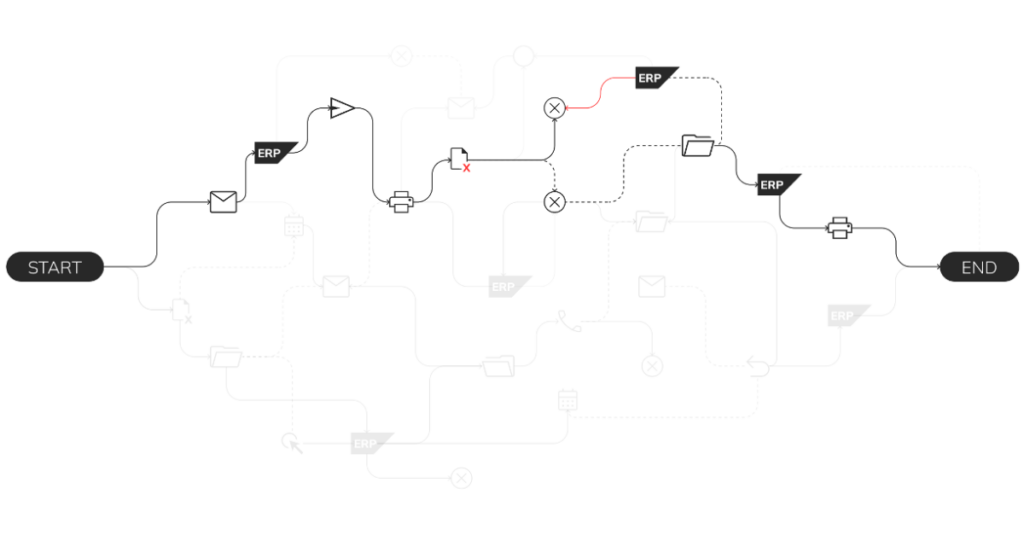
Looking at processes through interviews.
What makes task mining different
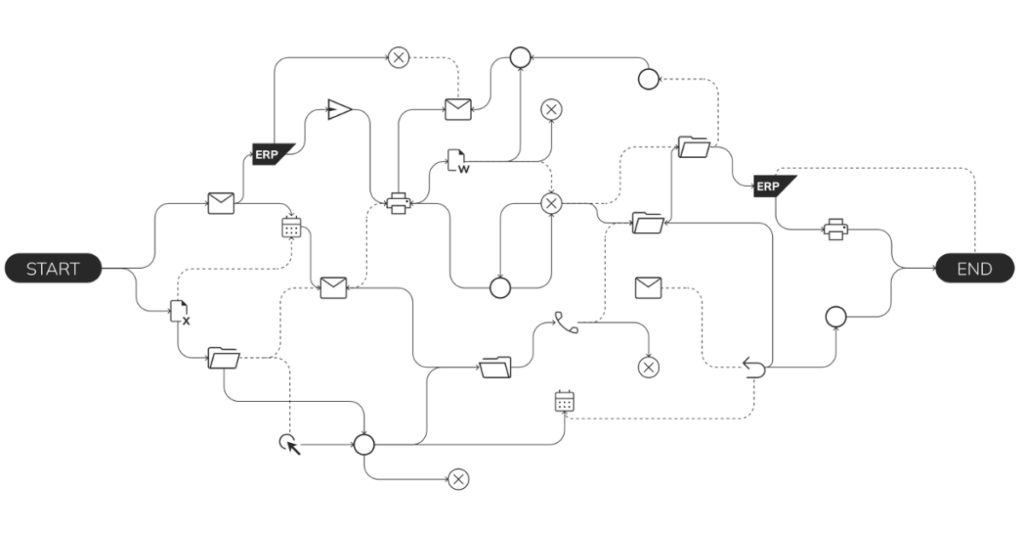
Task mining addresses precisely these limitations. Instead of selective surveys, it continuously records real workflows over a longer period of time. In doing so, it analyses cross-system interactions such as clicks, window changes and manual steps.
Scientific studies show that task mining delivers added value especially where human work is not fully reflected in system event logs (van der Aalst, 2022).
Interviews and task mining in direct comparison
The comparison clearly shows that interviews and task mining answer different questions. Interviews explain the why – task mining shows the what, how often and how long (van der Aalst, 2022).
Those who rely exclusively on interviews risk obtaining a distorted picture of the process. Those who rely exclusively on data lose context and acceptance. Empirical studies therefore recommend a combination of qualitative and quantitative analysis approaches (Deloitte, 2023).
Paxray as a bridge between people and data
Paxray does not see task mining as a substitute for human expertise, but as an objective complement. The data shows what is actually happening, while interviews help with interpretation and root cause analysis.
This combined approach follows best practices in modern process analysis, which deliberately bring together data and organisational knowledge (Gartner, 2024).
Looking at processes through task mining
Prioritisation, ROI and effectiveness of measures
A key advantage of data-based process analysis lies in prioritisation. Task mining shows which activities occur particularly frequently and where the greatest amount of time is spent. Management studies show that data-based prioritisation significantly increases the effectiveness of transformation measures (McKinsey, 2023).
Interviews provide valuable ideas, while task mining determines which of these are actually relevant and economically viable.
Conclusion: Modern process work requires both perspectives
Interviews and observations remain an important part of process work. At the same time, they alone are no longer sufficient to realistically capture complex digital processes. Task mining supplements these methods with objective, measurable data.
The combination of both approaches is now considered best practice for sustainable, effective process optimisation (Gartner, 2024; van der Aalst, 2022).
Many companies document their processes without being able to measure them accurately. Processing times, costs and variants often remain assumptions – with significant consequences for optimisation and automation decisions. Task mining provides a remedy here by making real workflows quantifiable, comparable and economically assessable. This article shows how task mining makes processes measurable and how
CRM and ERP migrations are among the most strategically important, but also the riskiest, transformation projects undertaken by companies. Studies show that a significant proportion of these projects fail to meet their time and budget targets – not because of technical shortcomings, but because of an insufficient understanding of the processes actually in place. Task
While companies are now beginning to consider Robotic Process Automation (RPA) as a rapid and lightweight approach for automating their repetitive and monotonous business processes, many organizations are unable to determine the impact of these implementations. That is one of the main reasons why Gartner currently classifies RPA in a phase called the trough of




 Learn more