Mastering Robotic Process Automation Projects
Have you ever thought about automating your business processes? No? Let us explain why you should and about the how to.
First, let’s take a closer look at the daily workflow of employees in a typical company. Here, many employees suffer from the execution of monotonous and day-to-day repetitive business processes. Automating these processes would free up capacity and allow employees to concentrate on value-adding and cognitive tasks. Second, globalization brought us many benefits, but also forced us to compete in an international market that can be very volatile. As a result, companies need to continuously increase their efficiency while remaining flexible to stay competitive. Consequently, companies can quickly increase their productivity by automating repetitive processes that require a lot of administration.
Interested in this kind of process automation?
If so, we recommend using Robotic Process Automation (RPA) as the technology of choice. RPA is a lightweight and fast approach to automating already digital yet manual tasks within your business processes across any type of legacy software, without the need to develop dedicated APIs. However, as practice-oriented researchers, we have observed that while an RPA implementation is often assumed to be a simple low-code implementation, it is quite challenging to integrate and maintain these robots in an enterprise context. In this regard, in reality up to 50% of all RPA implementation projects currently fail due to a lack of methodological support. We have therefore set ourselves the goal of remedying this deficit and have thus developed a methodological and scientifically validated framework for the successful implementation of RPA projects.
A Methodological Framework for Implementing RPA Projects
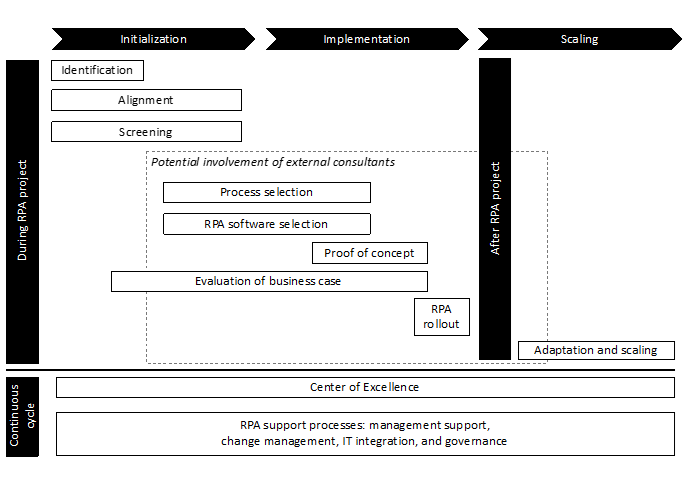
By iteratively integrating scientific knowledge and practical business process management experience, we have developed a framework that helps from the technical and economic view of process automation towards a holistic up-scaling of RPA within the whole enterprise.
Consequently, we assist aligning practice with rapid automation techniques, identifying appropriate processes and automation software, helping with the implementation, evaluating automation success through defined KPIs, and scaling RPA implementations up. In addition, we have observed that it is also essential to perform additional activities to ensure the long-term success of RPA. In doing so, we provide all kinds of best practices, possible workarounds, additional information, and tips that enable companies to successfully deploy RPA. Our research was published at the 19th International Conference of Business Process Management 2020 and awarded with the Best-Paper-Award (#Herm et al. 2020).
So, the next time you think about automating your business processes, come to us. We can provide you with scientifically validated methodological guidance and a plethora of practical experience for the successful implementation of RPA, making your hyperautomation journey a reality.




 Mehr erfahren